Every business today wants to talk to customers instantly, answer questions around the clock, and cut down on repetitive support work. That's exactly why chatbots have become one of the most in-demand tools for websites, apps, and messaging platforms. But not all chatbots are built the same way, and choosing the wrong type can leave customers frustrated instead of satisfied.
There are two broad categories: traditional chatbots (also called rule-based chatbots) and AI chatbots (powered by machine learning and natural language processing). While both aim to automate conversations, the way they think, learn, and respond is completely different.
In this blog, we'll break down what separates AI chatbot development from traditional chatbot systems, the pros and cons of each, and how to decide which one is right for your business.
What Is a Traditional Chatbot?
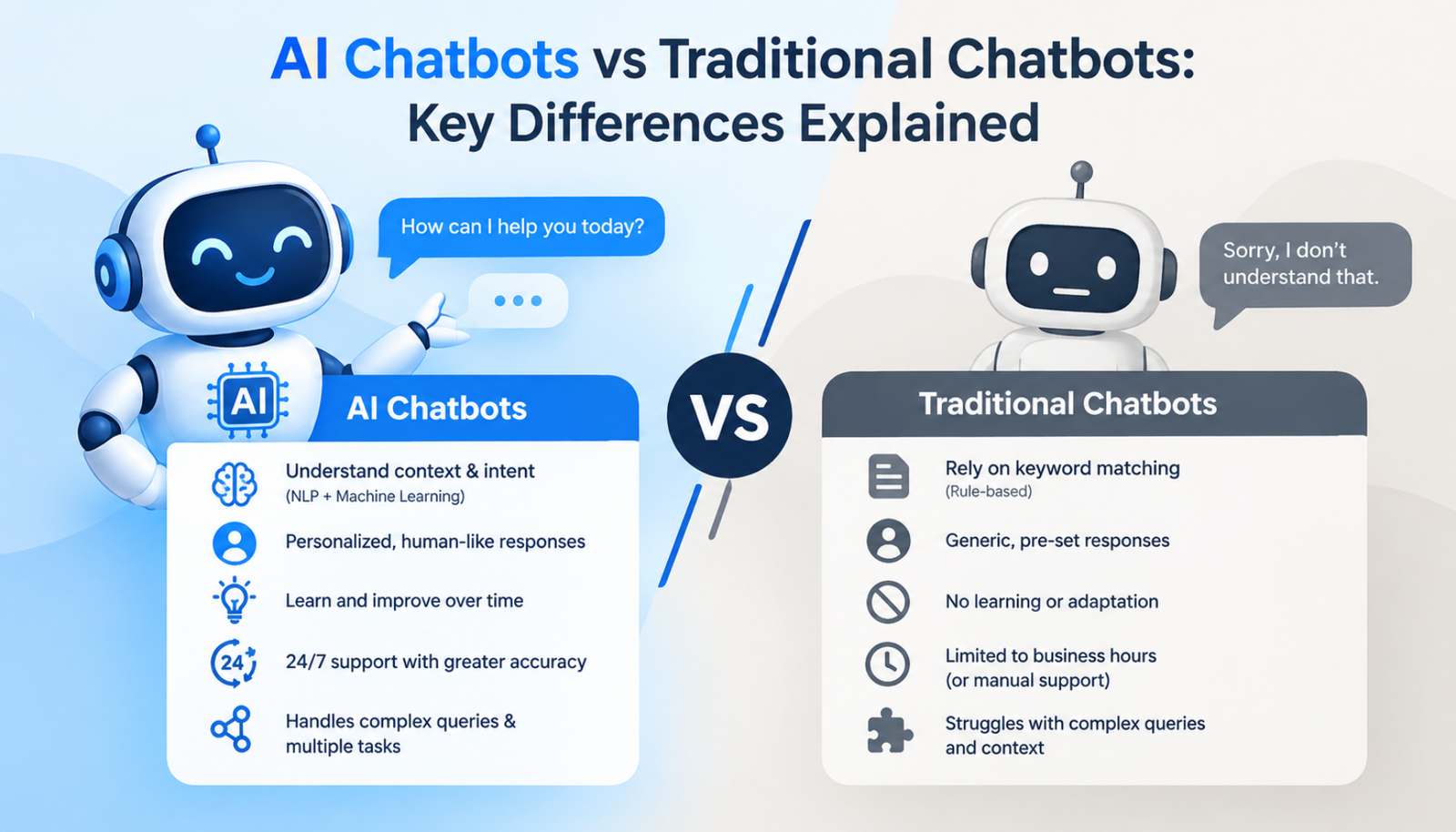
A traditional chatbot operates on a fixed set of rules and pre-written scripts. It follows a decision-tree structure — if a user types a specific keyword or selects a specific menu option, the bot responds with a predetermined answer. Think of it like a digital flowchart: input A leads to output B, every single time.
These bots are commonly used for:
Simple FAQ automation
Basic order tracking or status updates
Menu-driven customer support (e.g., "Press 1 for Sales, Press 2 for Support")
Appointment scheduling with limited options
Traditional chatbots are rigid by design. They can only respond to inputs they've been explicitly programmed to recognize. If a customer phrases a question differently than expected, the bot either fails to understand or gives an irrelevant answer.
What Is an AI Chatbot?
An AI chatbot uses technologies like Natural Language Processing (NLP), machine learning, and increasingly Generative AI (GenAI) to understand human language the way a person would — including slang, typos, context, and intent. Instead of matching keywords to scripts, AI chatbots interpret meaning and generate dynamic, human-like responses in real time.
Modern AI chatbot development services — like the ones offered at Oriol Infotech Solutions — go even further by training bots on a business's own data: PDFs, websites, FAQs, and internal documents using RAG-based AI (Retrieval-Augmented Generation). This means the chatbot doesn't just "chat" — it actually understands your business and gives accurate, context-aware answers.
AI chatbots can:
Understand natural, conversational language
Learn and improve from past interactions
Handle multiple topics within a single conversation
Offer multilingual and voice-enabled support
Integrate with CRMs, e-commerce platforms, and business apps
Key Differences Between AI Chatbots and Traditional Chatbots
1. How They Understand Language
Traditional chatbots rely on exact keyword matching. If your script doesn't account for a phrase, the bot gets stuck. AI chatbots use NLP and machine learning to understand context, sentiment, and intent — even when the phrasing is unfamiliar or contains errors.
2. Learning and Improvement
A traditional chatbot never gets smarter on its own. Every new scenario requires a developer to manually update the script. An AI chatbot, on the other hand, is a self-learning AI system — it continuously improves by analyzing real conversations and adapting its responses over time.
3. Conversation Flow
Traditional bots follow a linear, scripted flow. Users are guided through fixed menus or buttons, and the bot can't handle unexpected detours. AI chatbots support free-flowing, natural conversations, allowing users to ask follow-up questions, change topics, or provide extra context — just like talking to a real support agent.
4. Personalization
Because AI chatbots analyze user data, browsing history, and past interactions, they can deliver personalized recommendations and responses. Traditional chatbots treat every user identically, offering the same static replies regardless of who's asking.
5. Scalability and Complexity
Traditional chatbots work well for simple, high-volume, repetitive queries. But as your business grows and customer questions become more varied, rule-based systems require constant manual maintenance. AI chatbots scale naturally — they can manage complex, multi-turn conversations across sales, support, and lead generation without needing a new script for every scenario.
6. Integration Capabilities
Modern AI chatbots are built to plug into your existing tech stack — CRMs like HubSpot or Salesforce, payment gateways, WhatsApp, email, and social media APIs. Oriol Infotech's AI API integrations (OpenAI, Cohere, Gemini) and third-party API integrations make it possible to connect your chatbot to virtually any platform your business already uses. Traditional chatbots are usually far more limited and often built for a single use case or platform.
7. Cost and Development Time
Traditional chatbots are typically cheaper and faster to deploy since they rely on simple logic. AI chatbots require more upfront investment in training data, model integration, and testing — but they deliver significantly higher long-term ROI through better customer satisfaction, reduced support costs, and higher conversion rates.
8. Accuracy Over Time
A traditional chatbot's accuracy stays flat — it only knows what it was programmed to know. An AI chatbot's accuracy improves with every interaction as it's exposed to more real-world queries and fine-tuned with fresh data.
Which One Does Your Business Actually Need?
The right choice depends on your goals:
Choose a traditional chatbot if you have a small set of repetitive questions, a tight budget, and don't need dynamic conversations — for example, a simple FAQ widget or a store-hours lookup tool.
Choose an AI chatbot if you want to automate customer support, lead generation, and sales conversations at scale, offer 24/7 multilingual assistance, or need a bot that actually understands your business documents and data.
For most growing businesses — especially in e-commerce, healthcare, real estate, and SaaS — an AI-powered chatbot delivers far more value because it reduces support tickets, increases engagement, and converts more visitors into customers.
Real-World Use Cases of AI Chatbots
E-commerce: Answering product questions, recommending items, and recovering abandoned carts
Healthcare: Booking appointments and answering patient FAQs securely
Real Estate: Qualifying leads and scheduling property visits automatically
SaaS & B2B: Handling onboarding questions and routing complex queries to human agents
Hospitality: Managing reservations and guest queries instantly
Why Businesses Are Moving Toward AI Chatbots
Customer expectations have changed. People want instant, accurate, and natural responses — not a maze of menu options. Businesses that adopt AI-powered business automation are seeing measurable improvements in response time, customer satisfaction, and operational efficiency, while cutting down the manual workload on support teams.
This is where Generative AI (GenAI) business automation tools are transforming the game. Instead of a bot that just answers FAQs, businesses now deploy AI agents that can qualify leads, upsell products, and even complete transactions — all through conversation.
How Oriol Infotech Solutions Can Help
At Oriol Infotech Solutions, we specialize in building AI chatbots and conversational agents that go far beyond scripted responses. Our AI chatbot development process includes:
Training bots on your own business data using RAG-based AI
Multilingual and voice-enabled support
Seamless integration with your website, mobile app, WhatsApp, and CRM systems
Ongoing optimization through machine learning and predictive analytics
We also offer a full range of complementary services to support your digital growth, including:
AI software and business automation solutions
AI integration for existing systems
Generative AI tools and API integrations
AI-based website development
Custom business software and SaaS product development
AI digital marketing and SEO automation
Cloud deployment and DevOps automation
Whether you're a startup looking for your first chatbot or an enterprise ready to automate complex workflows, our team builds solutions tailored to your business goals — not a one-size-fits-all script.
Final Thoughts
The difference between AI chatbots vs traditional chatbots comes down to one thing: intelligence. Traditional chatbots follow instructions. AI chatbots understand, learn, and adapt. As customer expectations continue to rise, businesses that invest in AI-powered conversational agents will be better positioned to deliver faster support, personalized experiences, and stronger customer relationships.
If you're ready to move beyond scripted bots and build a chatbot that actually understands your customers, Oriol Infotech Solutions can help you design, train, and deploy the right AI chatbot solution for your business.
Get a Free Strategy Call and let's discuss how AI can transform your customer engagement.