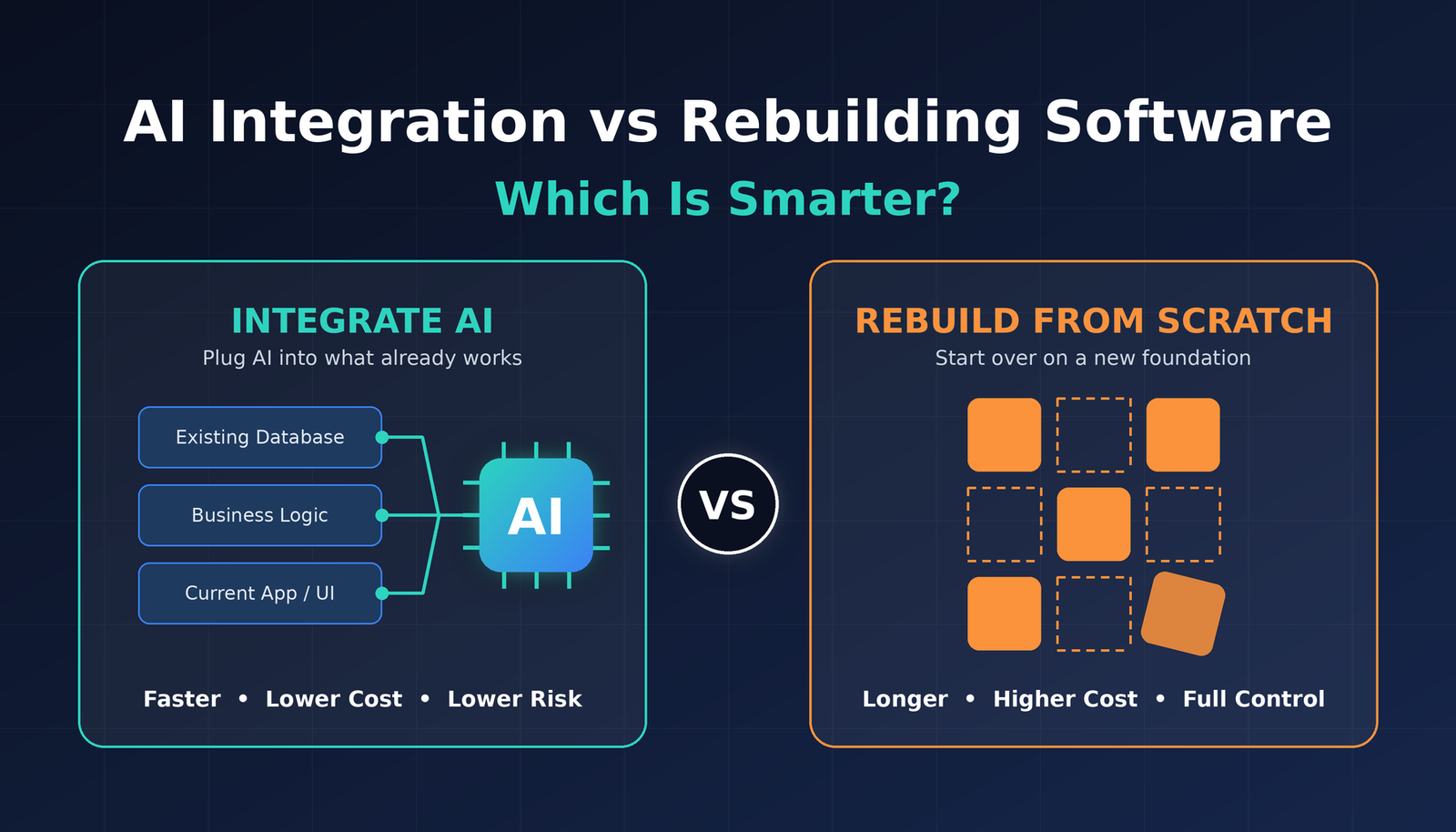
Businesses today are under increasing pressure to adopt artificial intelligence (AI) to improve efficiency, automate repetitive tasks, and deliver better customer experiences. However, when companies decide to introduce AI into their operations, they face an important question: should they integrate AI into their existing software or rebuild their systems from scratch?
Both approaches have advantages, but the right choice depends on your business goals, current technology, budget, and long-term growth plans. While rebuilding software may be necessary in certain situations, AI integration for existing systems can often deliver valuable improvements without the cost and disruption of replacing an entire technology infrastructure.
Understanding the differences between AI integration vs software rebuilding helps businesses make smarter technology investments. In this guide, we explore both approaches, their benefits, limitations, and the factors you should consider before choosing a strategy.
What Is AI Integration for Existing Systems?
AI integration for existing systems involves adding artificial intelligence capabilities to the software, applications, databases, and workflows a business already uses. Instead of replacing the entire system, developers connect AI tools and models to existing infrastructure to enhance its functionality.
For example, a company using customer relationship management (CRM) software could integrate AI to analyze customer behavior, predict sales opportunities, automate follow-up messages, and provide personalized recommendations.
Similarly, an organization using an established inventory management system could implement AI-powered demand forecasting to improve stock planning and reduce waste.
Common applications of AI software integration include:
AI-powered chatbots and virtual assistants
Automated document processing and data entry
Predictive analytics and business forecasting
Intelligent customer support systems
Personalized marketing recommendations
AI-driven reporting and workflow automation
The main advantage is that businesses can introduce new capabilities while preserving the software, processes, and data structures that continue to serve their needs.
What Does Rebuilding Software Mean?
Software rebuilding involves developing a new application or replacing an existing system with a redesigned solution. This may include changing the architecture, programming languages, databases, user interface, and business logic.
Organizations generally consider rebuilding when their current software has serious limitations that cannot be resolved efficiently through upgrades or integrations.
For example, an outdated application may lack reliable APIs, struggle with increasing data volumes, or depend on unsupported technologies. In such cases, rebuilding parts or all of the system may provide a more sustainable foundation.
The potential benefits of custom software redevelopment include:
A modern and scalable technology architecture
Improved application performance
Greater control over system design
Better alignment with changing business requirements
Reduced dependence on obsolete technologies
However, rebuilding often requires significant investment, extensive testing, employee training, data migration, and careful project management. It can also introduce operational risks if the transition is not planned properly.
Therefore, replacing existing software should be a strategic decision rather than an automatic response to the growing popularity of AI.
AI Integration vs Rebuilding Software: Key Differences
Although both approaches can improve business technology, they solve different problems.
1. Initial Investment
AI integration often requires a smaller initial investment because businesses can retain their existing applications and focus development efforts on specific improvements. Costs may include AI model usage, API development, data preparation, security measures, and system testing.
In contrast, rebuilding software can involve designing, developing, migrating, and deploying an entirely new application. These activities may require additional development resources and longer implementation timelines.
The more affordable option depends on system complexity, integration requirements, and the condition of the existing infrastructure.
2. Implementation Time
Integrating AI into a well-maintained application can be faster than rebuilding the entire platform. Businesses may begin with one use case, evaluate its performance, and expand gradually.
Rebuilding generally requires more extensive planning, development, testing, and migration. Complex applications may need months or longer to replace, depending on their size and dependencies.
For organizations seeking practical improvements without disrupting daily operations, AI integration services can offer a more incremental path to innovation.
3. Business Disruption
Replacing business-critical software can affect employees, customers, reporting processes, and connected applications. Data migration and employee training can also create temporary operational challenges.
AI integration for legacy systems may reduce disruption by allowing businesses to retain familiar workflows while introducing new capabilities in controlled stages.
Nevertheless, integration is not automatically risk-free. Poorly designed connections, unexpected data formats, and incompatible systems can cause problems. A phased implementation with appropriate testing is essential.
4. Flexibility and Scalability
A modern rebuilt application may provide greater architectural flexibility when the existing platform has become severely outdated.
However, AI integration can also support scalability when developers use suitable APIs, cloud infrastructure, modular components, and well-designed data pipelines.
The best option depends on whether the current system can support future requirements. Businesses should evaluate their expected growth, data volume, integration needs, and performance expectations before making a decision.
5. Long-Term Maintenance
AI integration may extend the useful life of existing software, but it does not eliminate the need to maintain the underlying application. Legacy dependencies, unsupported components, and outdated security controls still require attention.
A rebuilt platform may simplify maintenance if it replaces problematic architecture with a well-documented, supportable design. However, new software also requires ongoing updates, monitoring, security reviews, and technical support.
The smartest investment is the one that provides sustainable value over the application's expected lifetime.
Why AI Integration Is Often the Smarter Choice
For many businesses, integrating AI into existing software is a practical way to modernize operations without starting over.
1. Preserve Existing Technology Investments
Businesses often spend years developing software, refining workflows, training employees, and organizing operational data. Rebuilding everything may discard useful functionality and require expensive replacements.
With AI integration solutions, organizations can retain working components and enhance them where AI offers measurable benefits.
For example, a company may continue using its existing CRM while introducing AI-based lead scoring, customer segmentation, and automated reporting.
2. Improve Efficiency Without Replacing Everything
AI can automate repetitive tasks and help employees access relevant information more quickly. Integrating these capabilities into familiar applications can make adoption easier.
Examples include automatically categorizing support tickets, extracting information from invoices, summarizing lengthy documents, and identifying unusual transaction patterns.
These improvements allow teams to focus more time on strategic work instead of manual processes.
3. Start Small and Expand Gradually
A major advantage of AI integration for business software is the ability to begin with a clearly defined use case.
An organization might first introduce an internal knowledge assistant, measure its accuracy and adoption, and then expand into customer support or workflow automation.
This incremental approach helps businesses identify challenges early, manage costs, and prioritize the applications that deliver the greatest return.
4. Achieve Measurable Business Value
AI projects should address specific operational challenges rather than adopt technology simply because it is trending.
Companies can measure results through indicators such as processing time, customer response speed, error rates, employee productivity, and cost per transaction.
A focused integration project can help organizations evaluate these outcomes before committing to a much larger transformation.
For businesses exploring this approach, Oriol Infotech's AI integration for existing systems service page is a relevant starting point for understanding how AI capabilities can be incorporated into established software environments.
When Rebuilding Software Makes More Sense
Despite the advantages of integration, some systems require more fundamental changes.
Rebuilding may be the better choice when:
The application relies on unsupported technologies that create substantial security or maintenance risks.
The architecture cannot handle required workloads or expected growth.
Essential APIs and integration options are unavailable or prohibitively expensive to develop.
The system has serious performance or reliability problems.
Frequent workarounds make every new feature expensive to implement.
Regulatory, security, or operational requirements cannot be met reliably through targeted upgrades.
In these situations, continuing to add features to a fundamentally unsuitable platform may increase technical debt and long-term costs.
Businesses should also consider a hybrid strategy. Replacing a specific outdated component while integrating AI into other applications may offer a more balanced path than rebuilding everything at once.
How to Choose the Right Strategy for Your Business
Before choosing between AI integration and software rebuilding, evaluate the following factors.
Assess Your Existing Infrastructure
Review the current software architecture, databases, APIs, security controls, and application dependencies. Identify which components are reliable and which create ongoing limitations.
A technical assessment helps determine whether AI can be integrated safely and effectively.
Define Your Business Objectives
Identify the problem AI needs to solve. Your objective might be reducing manual data entry, improving customer support, accelerating document processing, or generating more useful business insights.
Clear objectives make it easier to select the right approach and measure success.
Evaluate Total Cost of Ownership
Do not compare only the initial development costs. Consider ongoing maintenance, AI usage fees, cloud infrastructure, training, security, upgrades, and future development.
AI integration cost can be lower when existing systems are suitable, but complex integrations may require substantial investment. Rebuilding may cost more initially while reducing certain long-term maintenance expenses.
Review Security and Data Privacy
AI systems may process sensitive customer information, financial records, or internal business documents. Assess data access permissions, encryption, retention policies, model-provider terms, and applicable compliance requirements.
Implement appropriate safeguards before connecting AI tools to production systems.
Run a Pilot Project
Start with a limited, measurable use case. Test the integration with representative data, review output quality, and evaluate how it affects existing workflows.
A pilot provides evidence to support decisions about expansion, additional integration, or a larger software modernization project.
The Future of Business Software Modernization
AI adoption does not necessarily require businesses to abandon their existing technology. Increasingly, modernization can involve connecting new capabilities to established systems while improving data quality, security, and interoperability.
Organizations that take this approach can introduce automation and intelligence in stages while retaining the applications that support their daily operations.
However, successful implementation requires more than connecting an AI model to a database. Businesses need reliable data, appropriate access controls, clear evaluation criteria, human oversight where necessary, and ongoing monitoring.
Choosing experienced AI integration developers can help organizations assess technical feasibility, select suitable tools, and create an implementation plan aligned with business priorities.
The goal is not simply to introduce AI. It is to solve meaningful business problems with technology that remains secure, maintainable, and adaptable.
Conclusion
So, which is smarter: AI integration or rebuilding software?
For businesses with stable, functional applications that need additional intelligence, AI integration for existing systems is often the more practical starting point. It can preserve previous investments, support gradual implementation, reduce disruption, and introduce automation without replacing an entire technology stack.
Rebuilding makes more sense when outdated architecture, serious technical limitations, or security concerns prevent the existing system from meeting business requirements.
Ultimately, the right decision depends on your current infrastructure, budget, business objectives, and long-term technology strategy. Assess your systems carefully, prioritize measurable outcomes, and begin with the approach that delivers sustainable value.
By taking a strategic approach to AI software integration, businesses can modernize intelligently and build a stronger foundation for future innovation.