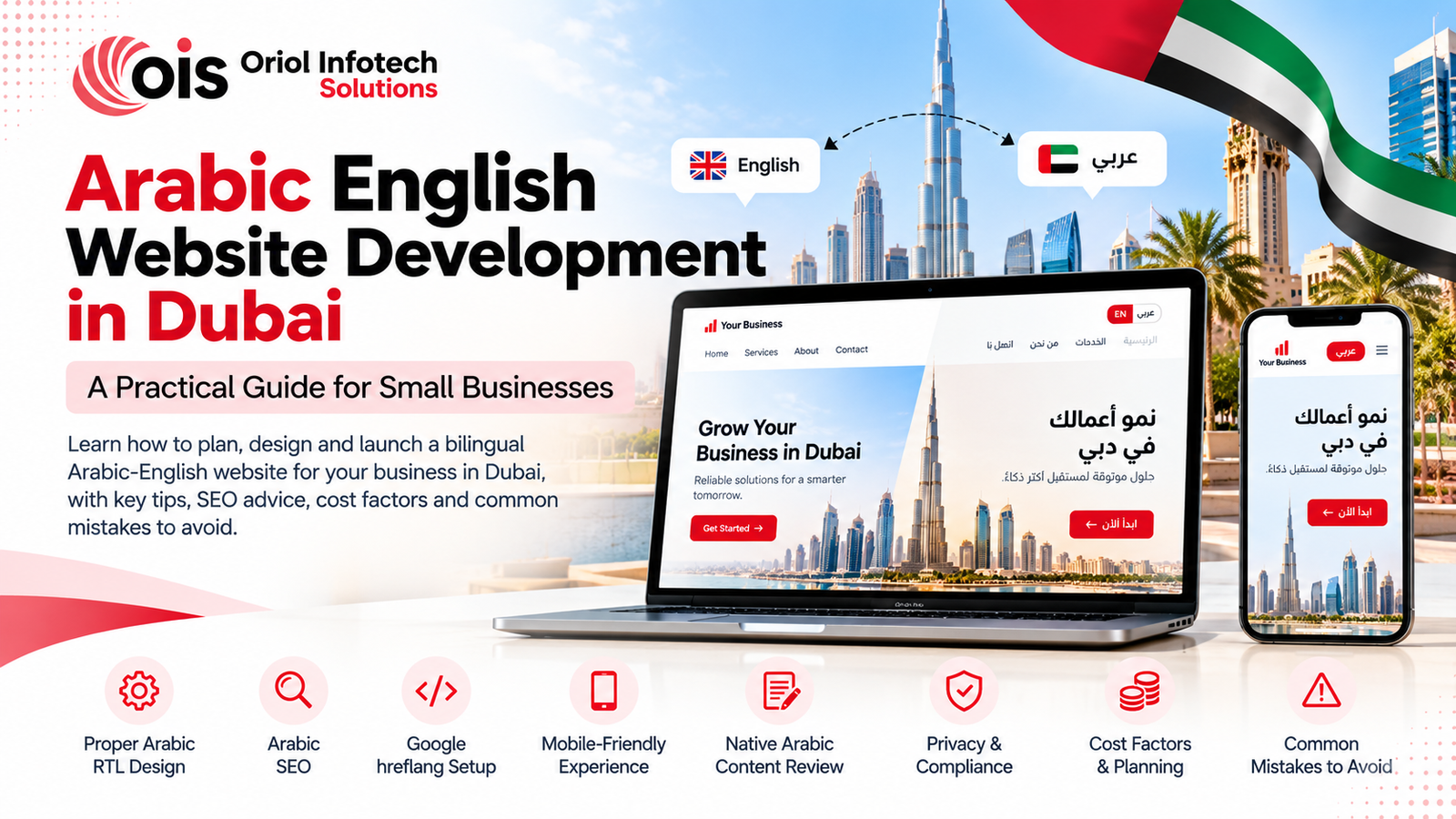
Arabic English Website Development in Dubai: A Practical Guide for Small Businesses
If you run a small or mid-size business in Dubai, you have probably asked yourself: do I need an Arabic version of my website, and how do I build it without wasting money? The short answer is that a good bilingual website is not an English site with Arabic text pasted in. It needs a proper right-to-left (RTL) layout, native-quality Arabic content and correct SEO setup so Google shows the right language to the right visitor.
This guide explains exactly what to plan, what to ask your developer, what drives the cost, and the mistakes that cause most bilingual sites to underperform. It also covers how to work smoothly with an Indian development partner if you want to keep your budget under control.
Why an Arabic-English Website Matters in the UAE
The UAE is one of the most connected markets in the world. According to DataReportal's Digital 2026 report, the country had about 11.3 million internet users, around 99% of the population, as of late 2025. Almost every customer you want to reach is online.
Arabic is the official language of the UAE, while English is widely used in business. A bilingual website helps you:
Reach Arabic-speaking customers who prefer to read and buy in Arabic
Look credible to government entities, larger companies and local partners
Rank for Arabic search terms that many competitors ignore
Build trust with families and decision-makers who are more comfortable in Arabic
What "Bilingual" Really Means: Translation vs Real RTL Design
Many UAE websites claim to be bilingual but only translate the text. Here is the difference.
Translated-only website
Same left-to-right layout, with Arabic text dropped in
Icons, arrows, sliders and menus still point the "English" way
Machine-translated copy that sounds unnatural to native readers
One set of keywords, usually just translated from English
Properly built bilingual website
Arabic pages use dir="rtl" and lang="ar", so the whole layout mirrors correctly, as recommended by the W3C
Navigation, forms, carousels and directional icons are mirrored for Arabic
Arabic copy written or edited by a native speaker
Separate Arabic keyword research, because people search differently in Arabic
Fonts designed for Arabic script, so text stays readable on mobile
Step-by-Step: How to Plan Your Arabic-English Website
1. Decide which pages need Arabic first
You do not have to translate everything on day one. Start with the pages that bring enquiries: home, main services or products, about, contact and your top landing pages. Add blog posts and help content in phases.
2. Choose a clean URL structure
A common and simple approach is language subfolders, for example yourbusiness.ae/en/ and yourbusiness.ae/ar/. This keeps both languages on one domain, which is easier to manage. Whatever you choose, keep it consistent across the whole site.
3. Set up hreflang correctly
hreflang tags tell Google which page is the English version and which is the Arabic version. Google's own documentation is clear on a few rules:
Each language version must list itself and all other versions
Links must go both ways. If two pages do not point to each other, Google ignores the tags
Use full URLs, including https and the domain
Use an x-default value for the page to show when no language matches
Use correct codes such as en, ar or ar-AE
4. Let visitors choose their language
Put a clear language switcher in the header on every page, and remember the visitor's choice. Avoid forcing a language based on location or browser settings. Google's guidance on multilingual sites recommends against automatic redirection based on the user's perceived language, because it can stop both visitors and Google from seeing all versions.
5. Get native-quality Arabic content
Machine translation is a good starting draft, not a final version. Have a native Arabic writer or editor review headlines, service descriptions, buttons and form messages. Small errors in Arabic can quickly damage trust.
6. Design for Arabic typography
Use fonts built for Arabic script (for example IBM Plex Sans Arabic, Cairo or Tajawal)
Allow extra line height, as Arabic text often needs more space
Test how headlines wrap, because the same sentence can be longer or shorter in Arabic
Choose one style of numerals and use it consistently for prices and phone numbers
7. Make contact easy, especially on WhatsApp
Many UAE customers prefer messaging over long forms. Add a WhatsApp button, a click-to-call number and a short enquiry form in both languages. Make sure form error messages and thank-you pages are translated too.
8. Plan for privacy and compliance
If your website collects names, phone numbers or emails, the UAE's Federal Decree-Law No. 45 of 2021 on the Protection of Personal Data is relevant. Publish a clear privacy policy in both languages and only collect the data you need. Check the exact requirements for your business with a qualified UAE legal advisor.
Bilingual Website Checklist Before Launch
Arabic pages have lang="ar" and dir="rtl"
Menus, icons, sliders and forms mirror correctly in Arabic
Language switcher visible on every page and links to the same page in the other language
hreflang tags are two-way, self-referencing and include x-default
Separate Arabic page titles and meta descriptions written for Arabic search
Arabic content reviewed by a native speaker
WhatsApp and call buttons work on mobile in both languages
Privacy policy and cookie notice available in Arabic and English
Page speed tested on mobile with Arabic fonts loaded
Both language versions submitted in your XML sitemap
What Affects the Cost of an Arabic-English Website in Dubai
Prices vary widely between agencies, so instead of guessing a number, understand what drives the quote. Ask every agency for an itemised estimate based on these factors:
Number of pages and templates: more unique layouts means more RTL design work
Content creation: whether you supply Arabic text, or the agency writes and translates it
Type of site: a company profile site costs less than an e-commerce store or booking portal
CMS and plugins: WordPress with a multilingual plugin, a custom CMS, or a headless setup
Integrations: payment gateway, CRM, WhatsApp API, ERP or booking systems
SEO setup: Arabic keyword research, hreflang, sitemaps and on-page SEO for both languages
Ongoing support: hosting, security updates, content updates and maintenance
Hiring a Local Dubai Agency vs an Indian Development Partner
Many UAE businesses work with development teams in India because of the overlapping working hours (India is only 1.5 hours ahead of the UAE) and lower development costs. Here is a fair comparison.
Local Dubai agency
Face-to-face meetings are easy
Often has in-house Arabic copywriters
Usually a higher budget for the same scope
Indian development partner
Working hours overlap almost fully with the UAE
Often more cost-efficient for design, development and maintenance
Works well with video calls, WhatsApp updates and shared project boards
You may need a native Arabic reviewer for final content, either your own team or a freelancer
A practical model for many SMBs: let the development partner handle design, RTL build, SEO setup and maintenance, and keep a native Arabic speaker (in-house or freelance) for final content approval.
Common Mistakes to Avoid
Publishing raw machine translation: it reads badly and hurts trust
Forgetting to mirror the layout: arrows and sliders pointing the wrong way look careless
One-way hreflang tags: Google ignores them if pages do not link to each other
Hiding the language switcher: visitors leave if they cannot find their language
Auto-redirecting by location: an English-speaking visitor in Dubai may be forced onto Arabic pages
Translating keywords instead of researching them: Arabic search terms are often different
Ignoring mobile: most browsing happens on phones, so test Arabic pages on small screens
Frequently Asked Questions
Do I need an Arabic version of my website in the UAE?
It depends on your customers. If you sell to Arabic-speaking customers, government entities or local families, an Arabic version builds trust and helps you rank for Arabic searches. For some purely B2B or expat-focused businesses, English may be enough at the start, with Arabic added later.
How much does a bilingual website cost in Dubai?
There is no fixed price. Cost depends on the number of pages, who writes the Arabic content, the type of site (company profile, e-commerce or portal), integrations and SEO work. Ask for an itemised quote that lists each of these separately so you can compare agencies fairly.
Should I use subfolders or subdomains for Arabic and English?
Both can work with Google. Many businesses choose subfolders such as /en/ and /ar/ because they are simple to manage on one domain. The most important part is setting up hreflang correctly and keeping the structure consistent.
Can I use Google Translate for my Arabic website?
You can use machine translation as a first draft, but a native Arabic speaker should review it before publishing. Unnatural Arabic can make your business look less professional.
How long does it take to build an Arabic-English website?
A small company website can usually be planned, built and tested in a few weeks, while e-commerce sites and portals take longer. The biggest delay is often content, so prepare your Arabic and English text early. [PLACEHOLDER: add Oriol's typical timeline]
Suggested Internal Links
Website design and development [LINK: service page]
Digital marketing and SEO [LINK: service page]
AI agents and WhatsApp bots [LINK: service page]
Website maintenance and support [LINK: service page]
Portfolio (Policy2Day, Kognition Academy) [LINK: portfolio page]
Ready to Build Your Arabic-English Website?
Oriol Infotech Solutions is an Indian IT company with offices in Indore, Gwalior and Mumbai. We design and develop websites, mobile apps, AI agents and digital marketing campaigns for small and mid-size businesses, with on-time delivery and full post-launch support. Because India and the UAE share almost the same working day, it is easy to plan calls and get quick updates.
Tell us about your business and we will suggest the right plan for your bilingual website.