If you run a business in Mumbai and want an app, you probably have three questions: how much will it cost, how long will it take, and how do you avoid picking the wrong company? This guide answers all three in plain language. It also covers two things many Mumbai businesses miss: India's new data protection rules and the Google Play update rules that can block your app from being published.
We are Oriol Infotech Solutions, a software company with an office in Mumbai (plus Indore and Gwalior). We build Android, iOS and cross-platform apps. This guide is written to help you decide well, whether you work with us or not.
Why app needs in Mumbai are different
Mumbai is India's financial capital, and that shows up in the kind of apps businesses here ask for. Maharashtra has the most DPIIT-recognised startups of any state (35,992 by the end of 2025), and Mumbai plays a major role in that growth (The Federal, Jan 2026).
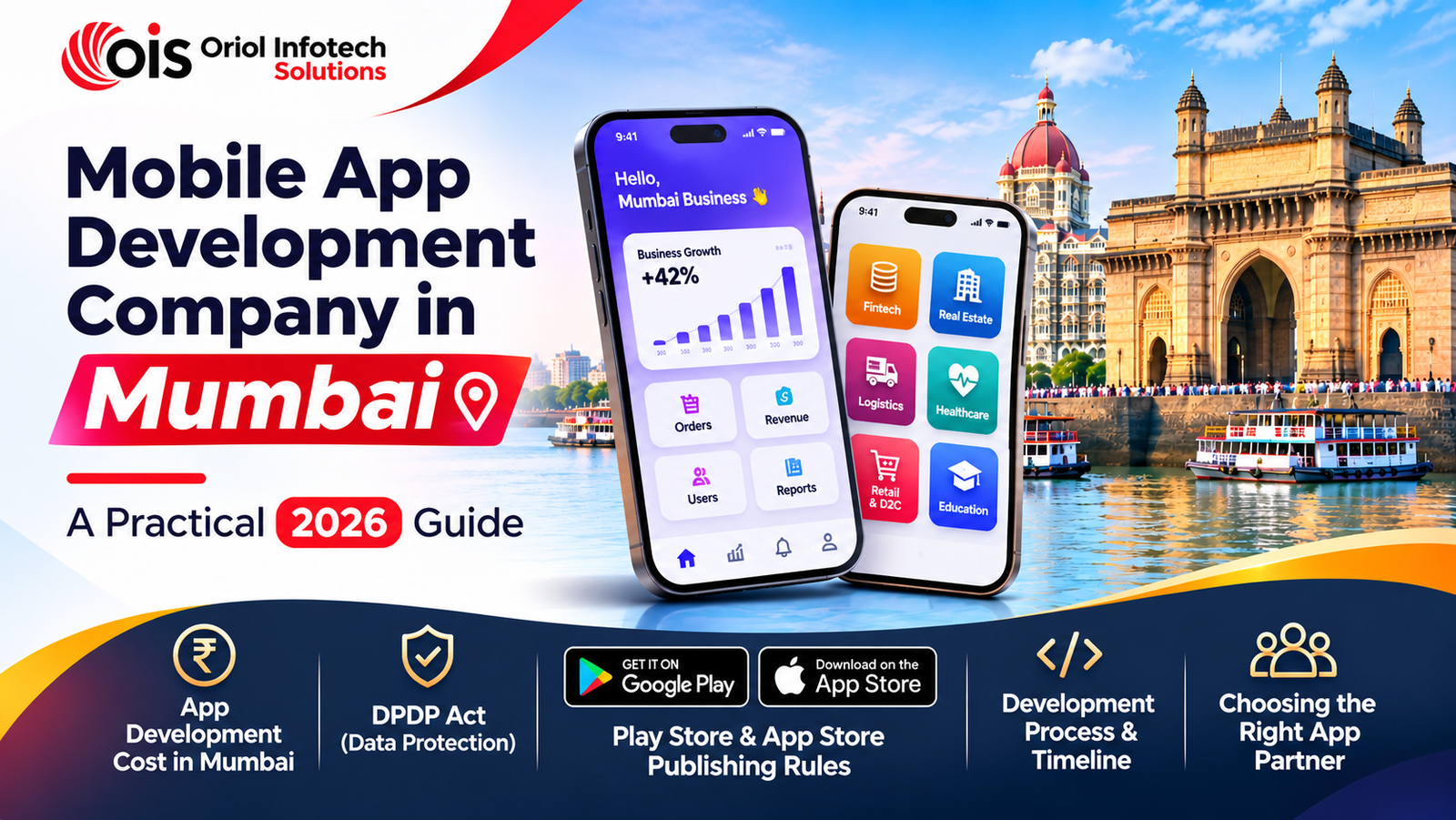
Common Mumbai app types we see in the market:
Fintech, insurance and lending apps – payments, policy tracking, loan apps for NBFCs and brokers.
Real estate apps – site visit booking, project brochures, broker and channel-partner apps.
Logistics, delivery and quick commerce – live tracking, rider apps, warehouse apps.
Healthcare and clinics – appointment booking, reports, teleconsultation.
Retail, D2C and wholesale trade – ordering apps for dealers and distributors, loyalty apps.
Education and coaching – class schedules, recorded lectures, test series, fee reminders.
Mumbai users also expect fast, light apps. Many people use the app on the move – on local trains, in traffic, with patchy network. So offline support, small app size and quick loading are not "extras" here; they decide whether people keep your app or delete it.
How much does app development cost in Mumbai?
There is no single price, because an app is not a single product. But it helps to see published ranges. One Mumbai-focused agency estimate puts most builds between ₹6 lakh and ₹45 lakh, with regulated fintech or marketplace platforms going to ₹1 crore or more (EngineerBabu). Their breakdown:
Basic app (few screens, simple login, basic admin): about ₹6–12 lakh, 6–9 weeks.
Mid-complexity app (payments, user roles, notifications, dashboards): about ₹15–40 lakh, 12–20 weeks.
Complex platform (marketplace, real-time tracking, heavy integrations): about ₹45 lakh–₹1.2 crore+, 24–40 weeks.
The same source notes that fintech, lending, insurance and payments apps carry a 20–40% premium for compliance and integration work. Treat these as market reference points, not a quote – your actual cost depends on scope.
What actually drives the cost
Number of user types – a customer app + delivery app + admin panel is three products, not one.
Platform choice – one cross-platform codebase (Flutter or React Native) is usually cheaper than separate native Android and iOS apps.
Integrations – payment gateways, UPI, KYC, SMS/WhatsApp, maps, ERP or CRM.
Real-time features – live tracking and chat need extra server work and cost more to run.
Compliance – consent screens, data storage location, audit logs and security testing.
Design depth – custom UI and animations vs. a clean standard design.
After-launch support – bug fixes, OS updates and server costs every year.
Rules your Mumbai app must follow in 2026–27
1. DPDP Act and Rules (data protection)
The Digital Personal Data Protection Rules, 2025 are rolling out in phases. The main obligations for apps – notice and consent, breach notification, verifiable parental consent for children's data, and data retention and erasure – take effect on 12 May 2027 (AZB & Partners). An app you start building today will likely go live close to that date, so build these features in now instead of patching them later:
Clear consent screens in simple language, with a way to withdraw consent.
Collect only the data you really need.
A process to delete user data on request.
Logging and alerts so a data breach can be detected and reported.
Parental consent flow if your users may be children (coaching, school, gaming apps).
2. RBI rules for lending apps
Many Mumbai NBFCs and fintechs build loan apps. The RBI Digital Lending Directions, 2025 (issued 8 May 2025) require explicit borrower consent for data collection, the right to revoke consent and request deletion, and storage of data on servers in India (Lawrbit summary). Your app partner should design for these from day one – along with your compliance team, because the regulated entity is responsible for meeting them.
3. Google Play target API level
From 31 August 2026, new apps and app updates on Google Play must target Android 16 (API level 36) or higher (Android Developers). If you are taking over an old app from another vendor, check this first – an outdated codebase may need upgrade work before you can even publish a bug fix.
Step-by-step: how to plan your app
Write down the one main problem your app solves (e.g. "dealers should place repeat orders without calling us").
List users and their top 3 actions each. This becomes your first version (MVP).
Decide platform: most Mumbai SMB apps start with one cross-platform build for Android and iOS.
Make clickable designs (wireframes) before coding. Changes are cheap at this stage.
Agree milestones and payments linked to working features, not just dates.
Test on real, low-cost Android phones and slow networks – that is what many of your users carry.
Launch, measure, then add features based on real usage.
How to choose a mobile app development company in Mumbai
Use this checklist when you meet vendors:
Live apps you can download – not just screenshots. Ask for Play Store / App Store links.
Similar industry experience – fintech, real estate or logistics experience saves time.
Written scope – screen list, features, what is not included, and the number of revisions.
Source code and account ownership – the Play Console, App Store account, server and code repository should be in your company's name.
Who actually works on your project – meet the developer or project lead, not only sales.
Security and compliance answers – ask how they handle consent, data deletion and where data is stored.
Post-launch support terms – response time, monthly cost and what counts as a "bug" vs. a "new feature".
Communication rhythm – weekly demo and a shared task board.
Common mistakes Mumbai businesses make
Building everything in version 1. Big first releases are late and over budget. Launch small.
Choosing only on lowest price. A cheap app that needs a rebuild in a year costs more.
No admin panel planning. Your team needs a simple back office to manage orders, users and content.
Ignoring compliance until launch. Consent and data deletion are harder to add later.
Vendor holds the accounts. If the Play Console is in the agency's name, you are locked in.
No budget for maintenance. Android and iOS change every year; your app must keep up.
Why Oriol Infotech for your Mumbai app
We will keep this honest and short:
Mumbai office, wider team. We have an office in Mumbai and development teams in Indore and Gwalior. You can meet us in person, and you get cost-efficient development from our central India team.
Full-stack in one place. App, admin panel, website, and connections to your ERP/CRM – plus AI chatbots and WhatsApp automation if you need them.
Clear milestones and on-time delivery. Fixed scope per milestone, weekly demos, and full post-delivery support.
You own everything. Source code, store accounts and servers stay in your name.
Code audit for existing apps. If you have an old or AI-generated app that is not working, our AI App Rescue / code audit service can review it and tell you whether to fix or rebuild.
Registered company (2021), MSME/Udyam and GeM registered.
Frequently asked questions
How much does it cost to develop an app in Mumbai?
Published market estimates put most Mumbai app builds between ₹6 lakh and ₹45 lakh, and complex or regulated platforms above ₹1 crore (EngineerBabu). Your cost depends on features, number of user types, integrations and platform. Ask for a written, feature-wise quote.
How long does it take to build a mobile app?
A simple app usually takes around 6–9 weeks, mid-level apps 12–20 weeks, and complex platforms 6 months or more, based on the same market estimate. Clear scope and quick feedback from your side are the biggest speed factors.
Should I build native or cross-platform (Flutter / React Native)?
For most business apps, cross-platform is a good choice – one codebase for Android and iOS saves time and cost. Native is better for heavy graphics, advanced camera/AR features, or deep device-level work.
Do I need to follow the DPDP Act for my app?
If your app collects personal data of people in India, yes. The main app obligations (consent, breach reporting, children's data, retention) start on 12 May 2027 (AZB & Partners). Building them in now is cheaper than retrofitting. Consult your legal advisor for your specific case.
Who owns the source code after the app is built?
You should. Put source code ownership and store account ownership in the contract before work begins.
Related reading
Talk to us about your app
Have an app idea, or an existing app that needs fixing? Send us a short note on what you want to build. We will reply with honest suggestions, a rough plan and the next steps – no pressure.
WhatsApp: +91-8519002191
Email: info@oriolinfotech.com
Website: www.oriolinfotech.com