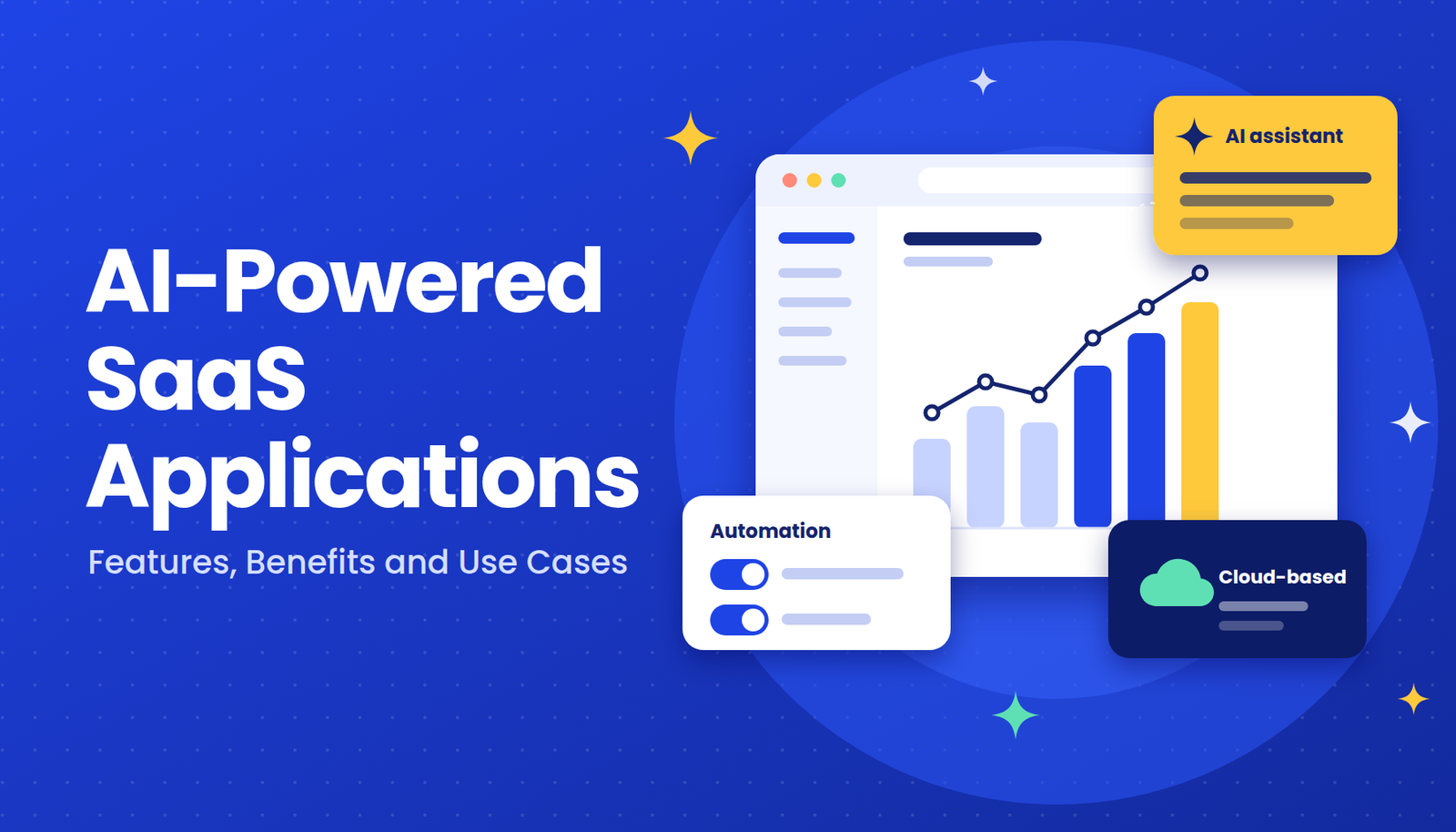
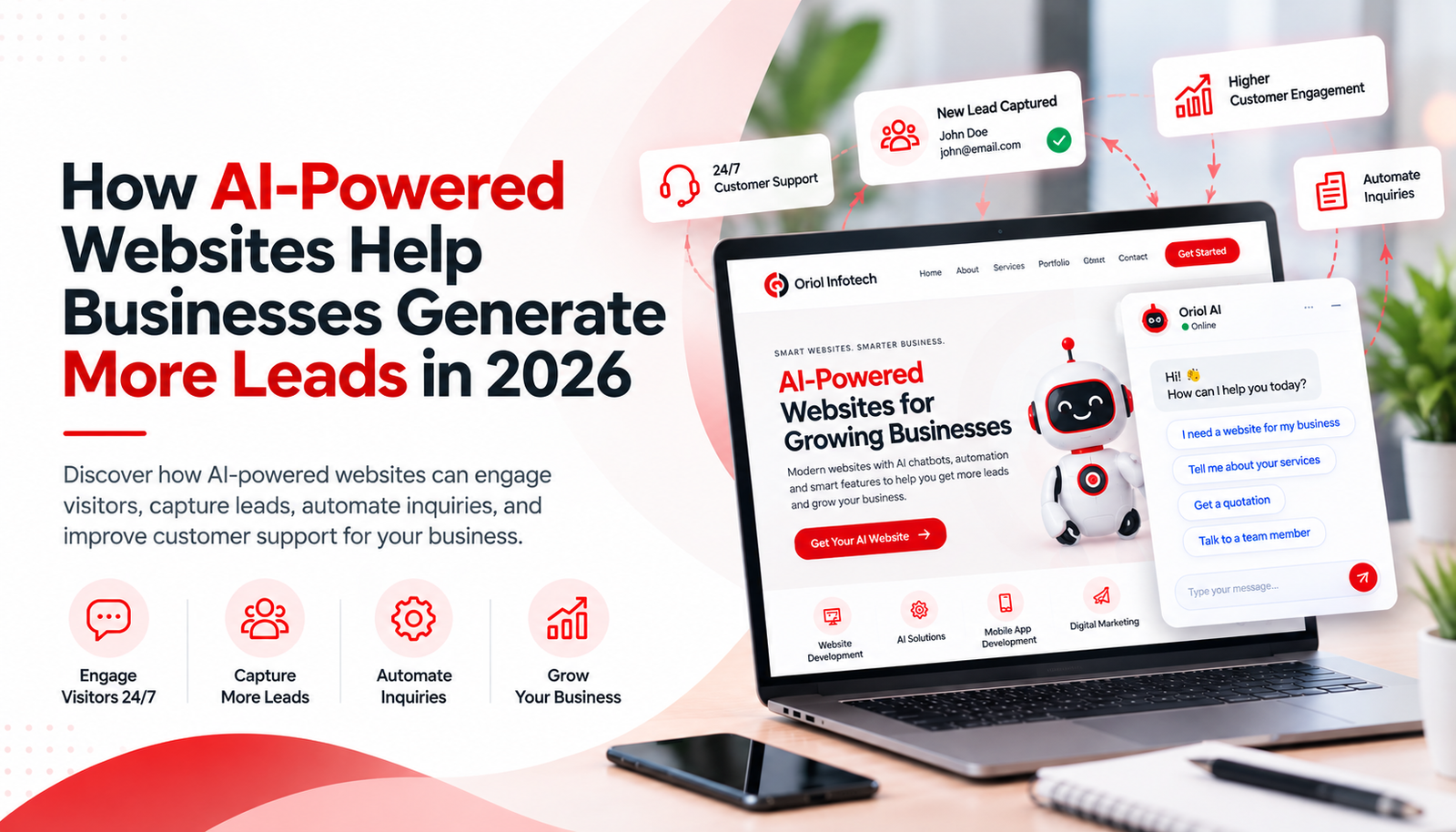
Businesses increasingly expect software to do more than store information or automate basic tasks. Modern applications are expected to understand user needs, analyze data, personalize experiences, and help teams make better decisions. This is where AI-powered SaaS applications are creating new opportunities for startups and established organizations.
By combining Artificial Intelligence (AI) with Software as a Service (SaaS), businesses can deliver intelligent features through cloud-based platforms without requiring customers to install and maintain complex software locally. From AI chatbots and predictive analytics to personalized recommendations and workflow automation, these applications can make digital products more useful and efficient.
For companies planning to launch a new software product or upgrade an existing platform, understanding the features, benefits, and practical use cases of AI-powered SaaS is an important first step.
What Are AI-Powered SaaS Applications?
AI-powered SaaS applications are cloud-based software products that use artificial intelligence to analyze information, automate tasks, generate content, identify patterns, or provide personalized recommendations. Users typically access these applications through a web browser or mobile interface, while the software provider manages hosting, updates, maintenance, and infrastructure.
Traditional SaaS applications often rely on predefined rules and workflows. AI-powered SaaS platforms can add capabilities such as natural language processing, machine learning, predictive analytics, and generative AI to support more context-aware experiences.
For example, a traditional customer relationship management (CRM) system may record customer interactions and display sales reports. An AI-powered CRM can also summarize conversations, identify potential leads, suggest follow-up actions, and help sales teams prioritize opportunities.
Similarly, an AI-enabled project management platform may analyze task histories, identify potential delays, summarize project updates, and recommend ways to improve team productivity.
The purpose is not simply to add AI to existing software. It is to solve meaningful user problems through intelligent, reliable, and well-integrated features.
Key Features of AI-Powered SaaS Applications
The most effective AI capabilities depend on the product's target audience, business objectives, available data, and intended workflows. The following features are common options for modern SaaS platforms.
1. AI Chatbots and Virtual Assistants
AI chatbots for SaaS applications help users find information, resolve common questions, and navigate product features through conversational interfaces. Unlike basic rule-based bots, AI assistants can use natural language processing to interpret questions and generate relevant responses.
For example, a customer support SaaS platform can use an AI assistant to answer frequently asked questions, summarize support tickets, and recommend relevant help articles. An internal business platform could help employees locate policies or understand company procedures.
When connected to approved business data, these assistants can provide more relevant answers. However, developers should implement access controls, response validation, and human escalation options to reduce the risk of inaccurate information.
2. Predictive Analytics and Business Intelligence
Predictive analytics in SaaS uses historical and current data to estimate possible future outcomes. Depending on the use case, machine learning models can identify patterns associated with customer churn, demand changes, sales opportunities, or operational risks.
A subscription-based software company, for instance, might analyze usage frequency, support requests, and subscription history to identify customers who may be at risk of cancelling. The platform can then notify account managers so they can investigate and take appropriate action.
Predictive insights are estimates, not guarantees. Their usefulness depends on data quality, model performance, and regular evaluation.
3. Personalized User Experiences
AI-powered personalization allows SaaS platforms to tailor recommendations, content, dashboards, and workflows to individual users or customer segments.
An e-learning platform could recommend courses based on learning progress, interests, and previous activity. An e-commerce SaaS product might suggest relevant products based on browsing behavior and purchase history.
Personalization can make applications easier to use by helping customers discover relevant information faster. It should remain transparent and respect users' privacy preferences.
4. Intelligent Workflow Automation
AI workflow automation combines AI models with predefined business rules, integrations, and approval processes to reduce repetitive work.
Examples include extracting information from invoices, classifying incoming support requests, drafting email responses, routing leads to the right team, and generating summaries from business documents.
For reliable results, businesses should define which tasks AI can complete independently and which require human approval. Sensitive financial transactions, account changes, and other high-impact actions may need additional verification.
5. Generative AI for Content and Document Processing
Generative AI SaaS solutions can create, summarize, classify, and transform information based on user instructions and available context.
Possible features include:
Generating first drafts of emails, reports, product descriptions, and proposals.
Summarizing lengthy documents and meeting transcripts.
Extracting important information from business files.
Rewriting content for different audiences or formats.
Answering questions about approved internal knowledge sources.
These capabilities can save time, but generated content may contain mistakes. Important outputs should be reviewed, especially when they involve legal, financial, medical, or other high-impact information.
6. Smart Search and Knowledge Discovery
AI-powered search helps users locate relevant information by understanding the meaning and context of a query rather than relying exclusively on exact keyword matches.
Semantic search can be especially useful in SaaS platforms containing large document libraries, knowledge bases, customer records, or technical resources. When combined with retrieval-augmented generation (RAG), a system can retrieve relevant information from approved sources and use it to prepare a contextual response.
Access permissions must apply to both search results and generated answers so users cannot retrieve information they are not authorized to view.
7. AI-Powered Recommendations
Recommendation engines in SaaS applications analyze relevant signals to suggest products, content, actions, or resources.
A marketing platform might recommend audience segments or campaign improvements. A project management system could suggest related tasks, while a learning platform might recommend the next course for a student.
Recommendations should be relevant to the user's goals and supported by measurable product outcomes. Businesses should monitor whether recommendations improve engagement or simply add unnecessary complexity.
Benefits of AI-Powered SaaS Applications
When AI addresses a genuine customer need, it can strengthen the value of a SaaS product. The actual results depend on implementation quality, user adoption, data availability, and ongoing monitoring.
Improved Productivity and Efficiency
AI-powered SaaS software can reduce manual effort by automating repetitive activities such as data entry, document classification, content drafting, and information retrieval.
Employees can spend less time on routine tasks and more time on work that requires judgment, communication, and problem-solving. Automation can also help teams manage increasing workloads without relying entirely on manual processes.
Better Data-Driven Decisions
AI can help users identify trends, compare information, and discover patterns that may be difficult to notice through manual analysis alone.
For example, an analytics platform could highlight changes in customer behavior or identify unusual patterns in operational data. Decision-makers can use these insights alongside business knowledge and other evidence.
Enhanced Customer Experience
Personalized recommendations, conversational assistance, intelligent search, and faster support workflows can make a SaaS product more convenient to use.
A well-designed AI feature should help users complete tasks with fewer unnecessary steps. Measuring task completion rates, customer satisfaction, and support resolution time can help determine whether the feature provides real value.
Greater Product Differentiation
AI integration in SaaS products can help a business offer capabilities that distinguish its software from competing solutions.
However, adding a chatbot or content generator is not automatically a competitive advantage. Differentiation is stronger when AI solves a specific problem for a clearly defined audience and integrates naturally into the product's core workflow.
Opportunities for Scalable Growth
Cloud-based SaaS architecture allows software providers to serve customers across different locations. AI features can extend that value by supporting automated processes, personalized experiences, and intelligent self-service.
To scale successfully, businesses must plan for model usage costs, response times, data storage, monitoring, and changing workloads. AI infrastructure should be designed around actual demand rather than assumed to scale without limits.
New Product and Revenue Opportunities
Businesses can offer AI capabilities as part of a standard subscription, a higher-tier plan, or usage-based pricing model.
For example, a document management platform might include basic search in its standard plan and offer advanced AI summaries or document extraction in a premium tier. Pricing should reflect customer value, operating costs, and the complexity of the feature.
Real-World Use Cases of AI-Powered SaaS
AI can support different business functions, but the best implementation depends on industry requirements and user needs.
1. Customer Relationship Management (CRM)
AI-powered CRM software can summarize customer conversations, score leads, recommend follow-up actions, and identify patterns in sales performance.
Sales teams can use these insights to prioritize prospects and improve customer communication. Human review remains important when AI-generated recommendations influence important sales or account decisions.
2. Marketing and Sales Automation
AI SaaS platforms for marketing automation can assist with audience segmentation, campaign analysis, content drafting, lead qualification, and performance reporting.
For example, a marketing dashboard could summarize campaign results and flag significant changes in conversion rates. Marketers can then investigate the underlying causes and decide what to test next.
3. E-Learning and Education Platforms
AI-powered e-learning SaaS applications can recommend learning materials, generate practice questions, provide personalized study support, and summarize learning progress.
These tools can support students and educators, but assessment criteria and educational recommendations should be designed carefully to avoid unfair or misleading outcomes.
4. Healthcare Administration Software
AI-enabled healthcare SaaS products can assist with administrative workflows such as document classification, appointment communication, and information organization.
Any use involving patient information requires strong privacy protections, appropriate access controls, and compliance with applicable laws. Clinical decision-support features require additional validation and professional oversight.
5. Finance and Accounting Software
AI-powered accounting SaaS can help categorize transactions, extract invoice information, flag unusual entries, and support financial reporting.
These features can reduce routine processing effort, but financial records and important decisions should remain subject to appropriate reconciliation, audit trails, and human review.
6. Human Resources and Recruitment
AI-enabled HR platforms can assist with job description drafting, employee self-service, policy search, and administrative document processing.
Recruitment-related AI requires particular care because automated screening and ranking may introduce bias or affect employment opportunities. Organizations should assess fairness, explainability, privacy, and human oversight before deployment.
7. Project Management and Team Collaboration
AI project management software can summarize discussions, organize action items, draft project updates, and identify possible scheduling risks.
These features can help teams spend less time maintaining records and more time coordinating work. Project managers should verify generated task assignments and risk assessments before acting on them.
8. E-Commerce and Subscription Platforms
AI-enabled e-commerce SaaS solutions can personalize product discovery, assist customer support, forecast demand, and identify unusual purchasing patterns.
Subscription platforms can also use analytics to understand engagement and detect possible cancellation risks. Any automated customer action should follow the business's policies and respect user preferences.
How to Develop an AI-Powered SaaS Application
Building a successful product requires more than connecting an AI API. A structured AI SaaS product development process helps businesses validate ideas, control costs, and prepare for growth.
Step 1: Identify a Specific Business Problem
Start by defining the target audience, the task that needs improvement, and the expected outcome. Research customer pain points and examine whether AI offers a meaningful advantage over conventional software.
Step 2: Validate the Idea and Define an MVP
Create a minimum viable product (MVP) containing the essential features needed to test the concept. Rather than building multiple AI capabilities at once, focus on one or two high-value use cases.
Step 3: Choose the Right AI Approach
Depending on the requirements, the product may use an existing AI model through an API, a retrieval-based system connected to business documents, a predictive machine learning model, or a custom-trained model.
Evaluate accuracy, latency, privacy, integration requirements, and ongoing costs before choosing an approach.
Step 4: Build Secure, Scalable SaaS Architecture
A production-ready platform needs appropriate authentication, role-based access controls, tenant isolation, secure APIs, reliable data storage, monitoring, and backup procedures.
Developers should also account for AI-specific requirements, including model access controls, prompt-injection risks, sensitive data handling, and safeguards against unauthorized actions.
Step 5: Test AI Features and User Workflows
Test the application with representative data and realistic user scenarios. Evaluate response quality, error rates, performance, usability, and security. Include human review wherever incorrect output could cause meaningful harm.
Step 6: Launch, Measure, and Improve
After launch, monitor usage, user feedback, model performance, infrastructure expenses, and business outcomes. Use the findings to refine prompts, workflows, interfaces, and model selection.
Working with an experienced SaaS product development company can help businesses plan these stages, integrate AI into their applications, and create a maintainable foundation for future improvements.
Challenges to Consider Before Adding AI to SaaS
Despite its potential, AI introduces technical and operational challenges that should be addressed early.
Data quality: Incomplete, outdated, or inconsistent data can reduce the quality of predictions and generated responses.
Privacy and security: Customer information must be protected through appropriate permissions, encryption, retention policies, and vendor reviews.
Accuracy and reliability: AI can generate incorrect or misleading answers, making evaluation and human oversight essential.
Integration complexity: AI features must work reliably with existing databases, APIs, and business workflows.
Operating costs: Model usage, infrastructure, storage, and monitoring can affect profitability.
User trust: Customers need clear expectations about AI capabilities, limitations, and the handling of their information.
Businesses should assess these risks alongside potential benefits before committing to a large-scale rollout.
Why Choose Oriol Infotech Solutions for SaaS Product Development?
Building an AI-powered SaaS product requires coordinated planning across product design, software engineering, integrations, cloud infrastructure, and security.
Oriol Infotech Solutions provides end-to-end SaaS product development services, supporting businesses from idea validation and MVP development to scalable, cloud-based platforms. Its service offering includes custom SaaS applications, multi-tenant architecture, subscription and billing systems, API integrations, dashboards, cloud deployment, and AI-powered capabilities.
Depending on the project requirements, an AI-enabled SaaS platform can incorporate AI chatbots, intelligent workflow automation, predictive analytics, content generation, and recommendation engines.
A product-focused development approach helps align features with user needs while considering performance, security, maintainability, and future growth.
If you are planning to launch a new SaaS product or enhance an existing application with AI, explore Oriol Infotech Solutions' SaaS Product Development services to learn more about the available development capabilities.
Frequently Asked Questions (FAQs)
1. What is an AI-powered SaaS application?
An AI-powered SaaS application is cloud-based software that uses artificial intelligence to automate tasks, analyze data, generate content, personalize experiences, or provide intelligent assistance through an online platform.
2. What are the main features of AI-powered SaaS applications?
Common features include AI chatbots, predictive analytics, intelligent search, workflow automation, personalized recommendations, generative AI, and automated document processing. The right features depend on the product's users and business goals.
3. What are the benefits of AI-powered SaaS?
Key benefits can include improved productivity, reduced repetitive work, faster information discovery, more personalized experiences, better data analysis, and new product capabilities. Results depend on implementation quality and user adoption.
4. Which industries can benefit from AI-powered SaaS?
Industries that may benefit include education, healthcare administration, finance, e-commerce, marketing, human resources, customer support, and project management. Each industry has different requirements for privacy, accuracy, and oversight.
5. How much does it cost to develop an AI-powered SaaS application?
The cost depends on product complexity, AI model selection, integrations, security requirements, user volume, and infrastructure needs. A focused MVP can help validate demand before a business invests in more advanced features. A reliable estimate requires a defined feature list and technical assessment.
6. How long does AI SaaS product development take?
The timeline depends on the scope, team, integrations, data readiness, and testing requirements. A limited MVP generally takes less time than a production-ready platform with multiple AI workflows, enterprise security, and complex integrations. The project should be estimated after requirements are reviewed.
7. Is AI-powered SaaS secure?
It can be designed with strong security, but AI does not make an application secure by default. Appropriate safeguards include encryption, authentication, role-based permissions, tenant isolation, secure integrations, monitoring, and careful management of data sent to AI services.
8. Can AI be added to an existing SaaS application?
Yes. AI capabilities can often be integrated into an existing SaaS platform through APIs, model services, retrieval systems, or custom machine learning components. The best approach depends on the current architecture, available data, and desired functionality.
Conclusion
AI-powered SaaS applications are expanding what cloud-based software can deliver. Features such as intelligent search, predictive analytics, conversational assistants, personalization, and workflow automation can help businesses create more useful digital products.
The most successful implementations begin with a clear customer problem, select appropriate AI technologies, and prioritize security, accuracy, usability, and measurable outcomes. Businesses should start with practical use cases, validate the results, and expand as they gain experience.
With thoughtful planning and the right technical foundation, AI SaaS product development can help startups and established companies build scalable software that evolves with customer needs.
To explore your next SaaS project, visit Oriol Infotech Solutions and review its SaaS product development capabilities.